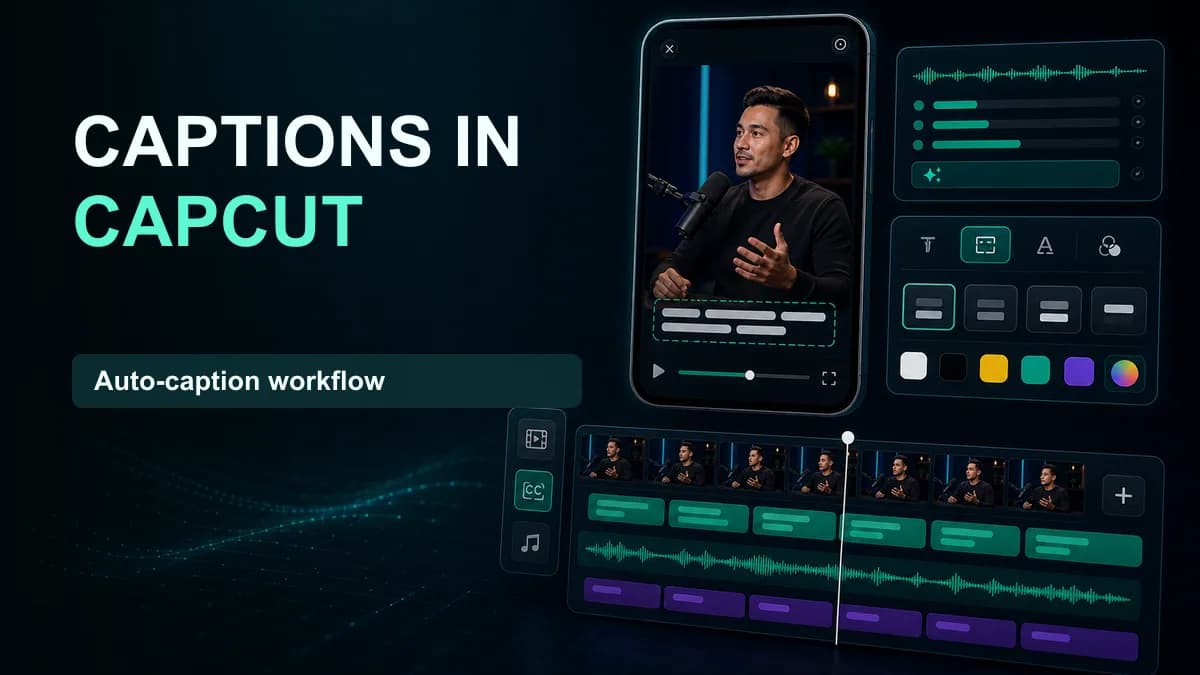













In CapCut, add the video to a project, open Captions, choose Auto Captions, select the audio source and spoken language, then click or tap Generate. The feature is available across CapCut Web, Desktop, and Mobile, although advanced options can vary by platform and region.
Generation is only the first pass. Use the checker above to estimate reading speed, then correct names, timing, line breaks, style, and placement before exporting.
CapCut caption steps by platform
| Platform | Open the caption tool | Generate | Best reason to use it |
|---|---|---|---|
| Mobile | Bottom menu > Captions | Auto Captions > language > Generate | Fast social edit on iPhone or Android |
| Desktop | Left toolbar > Captions | Auto Captions > source/language > Generate | Larger timeline and keyboard correction |
| Web | Left panel > Captions | Auto Captions > Recognise/Generate | No installation and easy browser access |
Interface wording changes between versions. If the exact label differs, look for Captions, Auto Captions, or Recognise Subtitles while the video clip is active.
Add auto captions in CapCut Mobile
- Create a project and import the final video edit.
- Tap Captions in the bottom toolbar.
- Choose Auto Captions.
- Select the correct language and audio source.
- Generate the caption track.
- Tap each caption to correct text and timing.
- Apply a consistent style and preview the entire vertical frame.
- Export to the camera roll and watch the file muted.
Generate after the main cuts. Removing a clip after captioning can leave stale text or timing gaps.
Add auto captions in CapCut Desktop
- Import the media and place it on the timeline.
- Open Captions in the left toolbar.
- Select Auto Captions, then choose the source track and spoken language.
- Generate and wait for caption clips to appear.
- Correct the transcript using the text panel and timeline.
- Apply font, size, background, position, and animation to the caption track or selected captions.
- Export a short range to check font rendering and sync before the final video.
Desktop is usually more efficient for long transcripts because the timeline, keyboard, and search space are larger. Use batch styling where available, but inspect exceptions after speaker changes or very short phrases.
Add auto captions in CapCut Web
Open the project in CapCut’s web editor, select Captions in the left panel, choose Auto Captions or Recognise, select the language, and generate. Correct and style the result in the browser.
For large files, upload and processing time may dominate the workflow. Keep the tab active when required and confirm that the source audio is present before retrying a failed job.
Correct CapCut captions efficiently
Pass 1: factual accuracy
Search for proper nouns, products, usernames, numbers, dates, prices, percentages, URLs, and negations. These errors cause the greatest harm when viewers rely on captions.
Pass 2: cue timing
The card should appear with the spoken phrase and disappear before the next conflicting phrase. Split dense captions and merge flashes that are too short. Watch speaker interruptions carefully.
Pass 3: line breaks
Keep captions to one or two lines on a phone. Break after a complete phrase. Avoid isolating an article, preposition, first name, currency symbol, or unit from the word it belongs to.
Pass 4: visual style
Choose a legible font, strong contrast, and restrained animation. Word-by-word highlights need accurate timing; if highlights lag behind speech, use a simpler card animation or correct the word timing.
Safe caption placement for TikTok, Reels, and Shorts
Keep essential text away from the bottom controls and right-side action buttons. Watch for faces, product UI, and lower thirds. A single global position may fail when the subject moves, so create intentional exceptions rather than placing all captions too high.
Test one bright shot and one dark shot. Outlines, shadows, or backgrounds should maintain contrast without covering too much of the image.
Fix CapCut auto captions not working
- Confirm that the video has audible speech and the correct clip is on the timeline.
- Select the correct language instead of relying on an unrelated default.
- Check the internet connection; generation may use online processing.
- Update or restart the app and reopen the project.
- Try a short section to identify a problematic file or project length.
- Remove overlapping music temporarily if it overwhelms speech.
- On desktop or web, verify the correct audio source.
- If a feature is missing, compare the mobile, desktop, and web versions available in the region.
Do not regenerate after extensive manual corrections without saving a copy; a new recognition pass may replace approved text.
Export and quality-control checklist
- Match the project aspect ratio and resolution to the destination.
- Keep frame rate consistent with the source unless conversion is intentional.
- Watch the opening, fastest sentence, speaker change, and final CTA.
- Confirm no caption extends beyond the last spoken word.
- Check the exported MP4, not only the editor preview.
- Upload a private draft and inspect platform cropping and controls.
- Preserve a clean master and subtitle file where needed.
CapCut captions FAQ
Are CapCut auto captions accurate?
Clear speech can produce a strong draft, while accents, background noise, overlapping speakers, and specialized terms require more correction. Accuracy should be measured on the final source language and audio conditions.
Can CapCut translate captions?
Translation availability varies by platform, plan, language, and region. Review translated meaning, names, idioms, line length, and timing with a fluent speaker.
Can I apply one style to every caption?
CapCut versions provide track, batch, or multi-selection styling controls. Apply the base style before making card-specific exceptions, then scan the full timeline for mismatches.