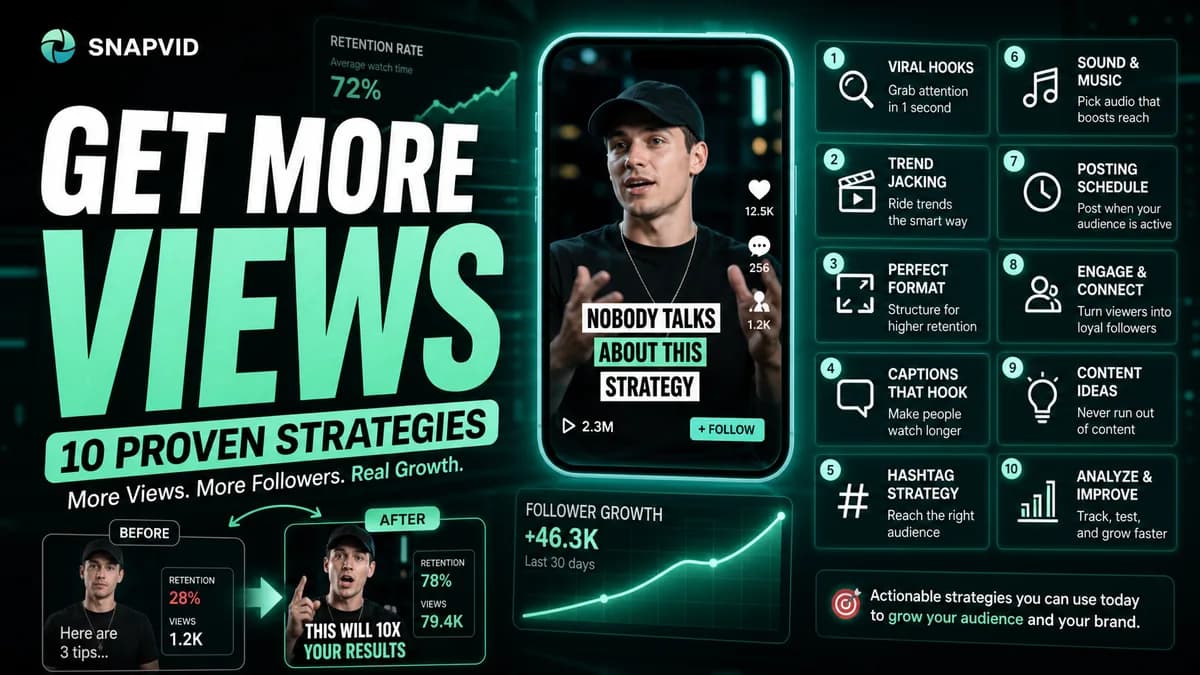













Getting more TikTok views and getting more followers are related but separate jobs. A video earns distribution through viewer satisfaction and eligibility. It earns followers when the content creates a reason to visit the profile and the profile promises more of the same value.
Enter views, profile visits, follows, and average watch percentage in the calculator above. It identifies whether the next test should focus on retention, the video-to-profile bridge, profile conversion, or scaling a proven format.
The TikTok growth funnel
| Stage | Useful metric | Typical problem | Next test |
|---|---|---|---|
| Impression to view | Early hold / swipe-away behavior | First image or promise is unclear | Show result, tension, or proof immediately |
| View to meaningful watch | Average watch time and completion | Setup is longer than the value | Remove context or move it after proof |
| Watch to action | Saves, shares, comments | Content is watchable but not useful or social | Add a reusable artifact or specific question |
| View to profile | Profile views / video views | Topic does not imply deeper expertise | Connect post to a named series or promise |
| Profile to follow | Followers / profile views | Bio and recent grid do not confirm the promise | Align bio, pinned posts, and next episodes |
Track these rates by format and topic. Large raw numbers can hide a weak conversion stage.
1. Replace introductions with proof
Start with the result, experiment, before/after, surprising image, or specific claim. Put credentials and background after the viewer sees why they matter. Test two openings on different posts that deliver the same type of payoff.
Do not manufacture a misleading curiosity gap. If the opening promises a setting, price, method, or result, show it inside the video.
2. Build repeatable series, not isolated hits
Choose a format that can support at least ten audience questions. Use a recognizable opening, visual grammar, and payoff while changing the topic and evidence. Name the series once the mechanism works across several posts.
A series improves follow conversion because the next video is predictable without being identical.
3. Optimize for TikTok search
Answer the exact phrase a viewer would type. Say it in the voiceover, show it on screen, and write a natural caption that reinforces the topic. Use a small set of relevant hashtags instead of a block of generic tags.
Search-led content should answer quickly, then demonstrate the edge case. Review search terms and comments for the next episode.
4. Shorten the distance to payoff
Mark the first visible proof and the final payoff on the timeline. Remove any sentence, animation, pause, or repeated example that does not improve comprehension. When the idea needs context, layer it under an active demonstration rather than delaying the action.
Compare average watch time and percentage watched. A longer video can still outperform when it creates more useful watch time and delivers a complete answer.
5. Create save-worthy artifacts
Checklists, settings, templates, scripts, shot lists, formulas, comparisons, and step sequences give viewers a reason to save. Put the useful artifact inside the video; do not make the entire answer depend on a comment keyword or external download.
6. Ask for a specific comment
“What do you think?” produces vague responses. Ask which of two approaches fits the viewer, what step failed, what tool they currently use, or which example should be tested next. Then use recurring questions as research, not just engagement volume.
7. Make the profile continue the video
The bio should state who the account helps and what recurring outcome it delivers. Pin three posts that orient a new visitor: strongest proof, best starting guide, and clear point of view or offer. Recent posts should support the same niche often enough that following feels coherent.
If profile visits are healthy but follows are weak, edit the profile before changing every video.
8. Publish at a sustainable test cadence
Consistency matters because it creates samples. Pick a cadence that leaves time to review analytics and improve the next batch. Three intentional posts per week can teach more than daily unrelated trends.
Record hypotheses before publishing. Change one major variable per test: hook, proof timing, length, caption density, visual format, or CTA.
9. Collaborate with audience overlap
Choose creators whose viewers share the problem, not only accounts with large follower counts. Build a concept where both participants add necessary expertise, access, or entertainment. Agree on rights, disclosure, approvals, posting, and measurement.
Track qualified profile visits and follows, not only combined views.
10. Scale proven organic posts carefully
Paid promotion can extend a post that already retains and converts the right audience. It cannot repair a weak promise or confused profile. Separate paid and organic results and judge downstream actions such as leads, sales, or qualified follows.
Never buy followers, views, likes, or automated engagement. Inflated counts damage measurement, can expose the account to platform enforcement, and do not create an audience that watches future posts.
A weekly TikTok review
- Group posts by repeatable format and topic.
- Compare early hold, average watch, completion, saves, shares, comments, profile visits, and follows.
- Watch the strongest and weakest posts without sound.
- Write one difference that could plausibly explain the gap.
- Design the next post to test that difference while keeping the rest stable.
- Update the hook and format library with the result.
Use the account median rather than one viral post as the baseline. Review follower quality through later watch behavior and relevant conversations, not only the acquisition count.
TikTok growth FAQ
Can a new account get views without followers?
Yes. TikTok can recommend content beyond an existing follower base. Clear topic signals and viewer response matter, but no tactic guarantees distribution.
How often should I post on TikTok?
Choose a repeatable cadence that supports learning and quality. Increase frequency only when research, production, correction, and review remain reliable.
What is a good follow conversion rate?
There is no universal threshold. Compare profile-to-follow conversion across your own formats, topics, traffic sources, and time windows. The calculator provides diagnosis, not a platform benchmark.