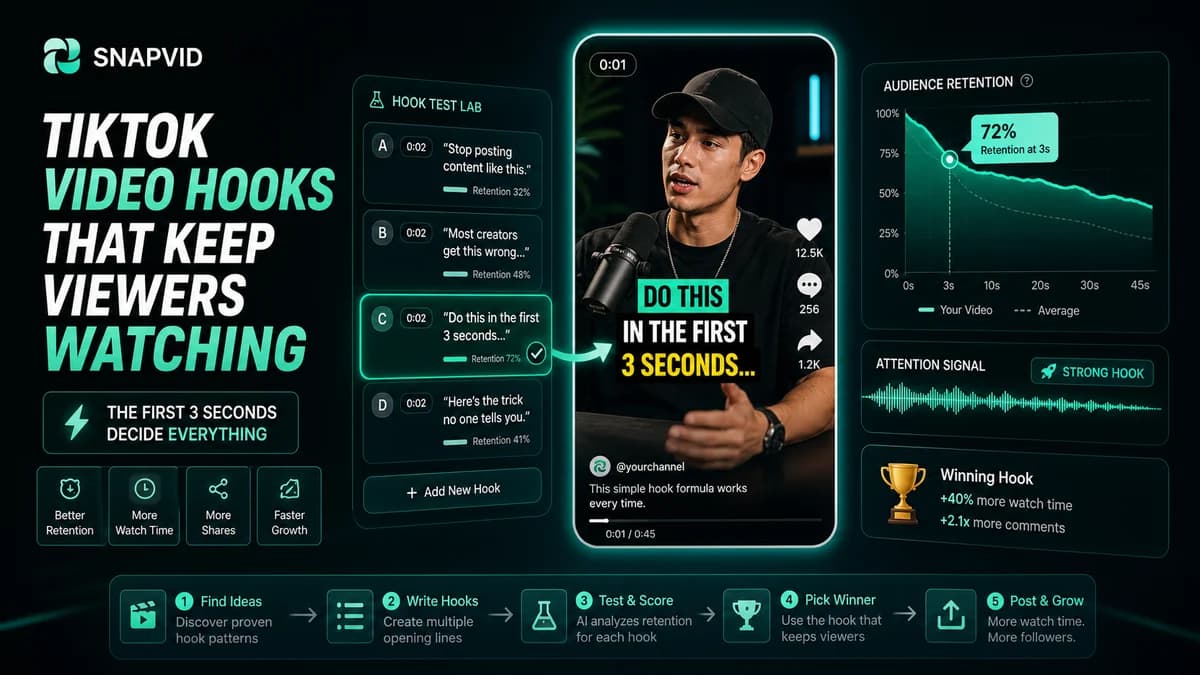













A TikTok hook has one job: make the viewer understand why the next few seconds matter.
The best hooks are not always loud. They are clear, specific, and easy to process on a small screen.
Open on the tension
Start with the problem, mistake, contradiction, or result. The viewer needs a reason to keep watching before they understand the full context.
Examples of strong angles include a mistake to avoid, a surprising result, a before-and-after, or a simple promise.
Make the caption match the hook
If the spoken hook and the written caption fight each other, the video becomes harder to follow.
Use captions to reinforce the same idea, not to introduce a different thought.
Keep it short enough to read
Most hooks should fit into one or two short caption lines. If the opening sentence is too long, rewrite it before you record.
The caption should support speed, not slow the viewer down.
Test multiple versions
Write five hooks for the same topic. One can be direct, one contrarian, one story-led, one result-led, and one question-led.
This is why a hook generator is useful: it helps you see angles before committing to the edit.
Turn the hook into a workflow
Save hooks that work. Over time, your best openings become a creator playbook you can reuse across TikTok, Reels, Shorts, and LinkedIn clips.
Test the hook before the full edit
A hook should make the viewer curious and oriented at the same time. If it is vague, the viewer has to work too hard. If it is too clever, the point can disappear.
Write three hook options before editing, then choose the one that makes the next sentence feel necessary.
Pair the hook with visible proof
The first visual should confirm that the video can deliver on the promise. Use captions, framing, or a quick example to make the payoff feel close.
SNAPVID helps when you want the hook, transcript, caption styling, and final pacing to stay in the same production flow.
Review retention patterns
After publishing, compare hooks that created comments, rewatches, and saves. The best hook style is not always the loudest one; it is the one that attracts the right viewer and sets up a satisfying payoff.
Keep a swipe file of your strongest openings so future edits start from evidence instead of guesswork.
Make hooks easier to reuse
Turn winning openings into reusable patterns. Save the setup, the first caption line, and the visual cue so the next edit starts with a proven structure instead of a blank page.