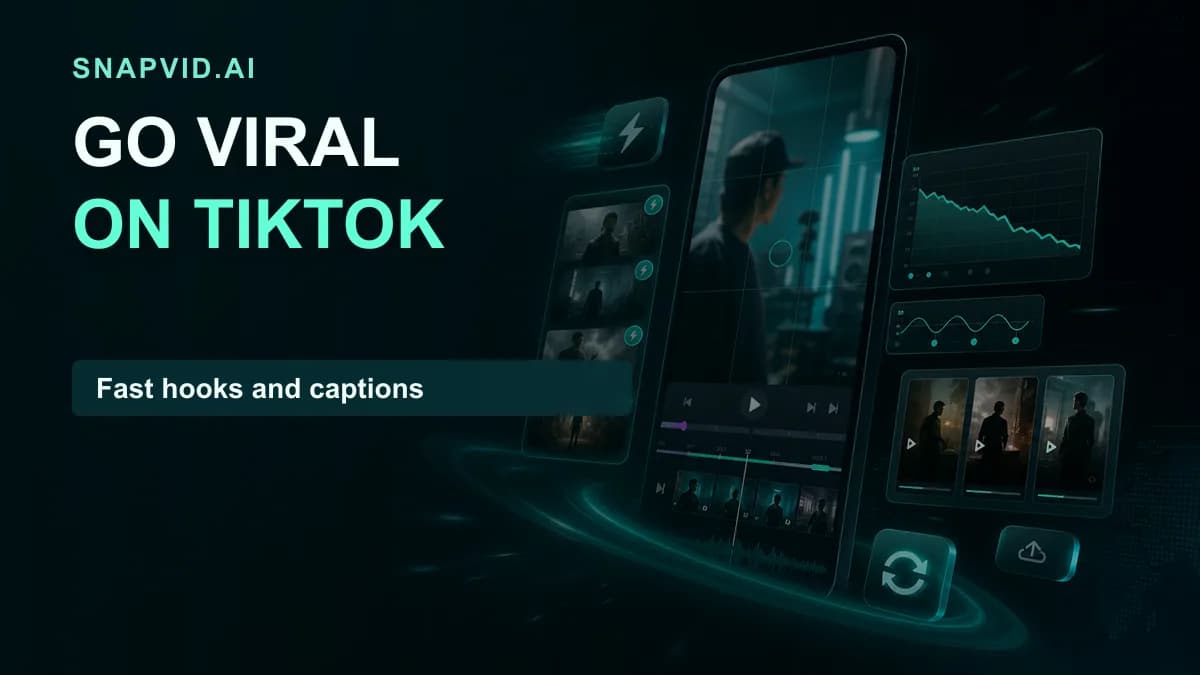













Nobody can guarantee that a TikTok will go viral. What you can build is a repeatable process that gives every video a clear promise, removes avoidable drop-off, and turns performance data into a better next edit.
Virality is an outcome, not an editing preset. Focus on attracting the right viewer and delivering a satisfying payoff; inflated views from the wrong audience rarely create durable growth.
Start with one viewer promise
Write one sentence that says what the viewer will learn, feel, or see by the end. If the sentence contains two ideas, split the video. This promise should guide the spoken hook, the first caption, the visual proof, and the ending.
Avoid vague openings such as “you won't believe this.” A specific tension or result gives people a reason to stay and makes it easier to judge whether the edit delivers.
Show proof in the first seconds
The first visual should confirm that the payoff is real. Show the result, the mistake, the surprising object, the before-and-after, or the person making the claim. Do not spend the opening on a logo animation or background context.
Keep the first caption short enough to read at a glance. Spoken words and on-screen text should reinforce the same idea rather than compete.
Edit for comprehension before speed
Remove dead air and repeated setup, but do not cut so aggressively that the meaning disappears. A strong TikTok feels fast because each beat advances the idea, not because every pause is removed.
Use zooms, B-roll, sound effects, and transitions when they supply proof or reset attention. Decorative changes every second can make a useful explanation harder to follow.
Make captions work on a phone
Correct names, numbers, and product terms. Keep lines short, use strong contrast, and protect interface areas near the top, bottom, and right side. Watch the final export muted on a real phone before publishing.
Captions improve access and comprehension, but they cannot rescue an unclear story. If the transcript is confusing, tighten the script or reorder the edit first.
Build a publishing experiment
Prepare several hooks for the same core idea, but change one meaningful variable at a time. You might test a result-led opening against a mistake-led opening while keeping the body and payoff consistent.
Use a caption and cover that restate the subject clearly. Hashtags can add context, but they do not replace audience fit or a compelling video.
Read the right analytics
Look at the drop-off in the opening, average watch time, completion, rewatches, saves, shares, profile visits, and qualified comments. A high view count with weak completion or no relevant action may not be a useful win.
Compare videos of similar length and topic. One post is noisy; patterns across a series are more reliable. Record the hook, duration, structure, visual proof, and result in a simple log.
A repeatable TikTok workflow
- Define one viewer and one payoff.
- Write three specific hooks.
- Put visible proof in the opening.
- Cut every beat that does not support the promise.
- Correct and style captions for mobile.
- Publish with one clear call to action.
- Review performance after enough data has accumulated.
- Carry one learning into the next version.
SNAPVID can help connect the short-form edit, captions, pacing, and export so the process is easier to repeat. The goal is not to manufacture a guaranteed viral hit; it is to publish stronger tests often enough to discover what your audience genuinely values.